Deck vs Cabin on an Open Trip: What Life on Board Is Like
Flores Boat Trip Expeditions Editorial Desk 11 min read
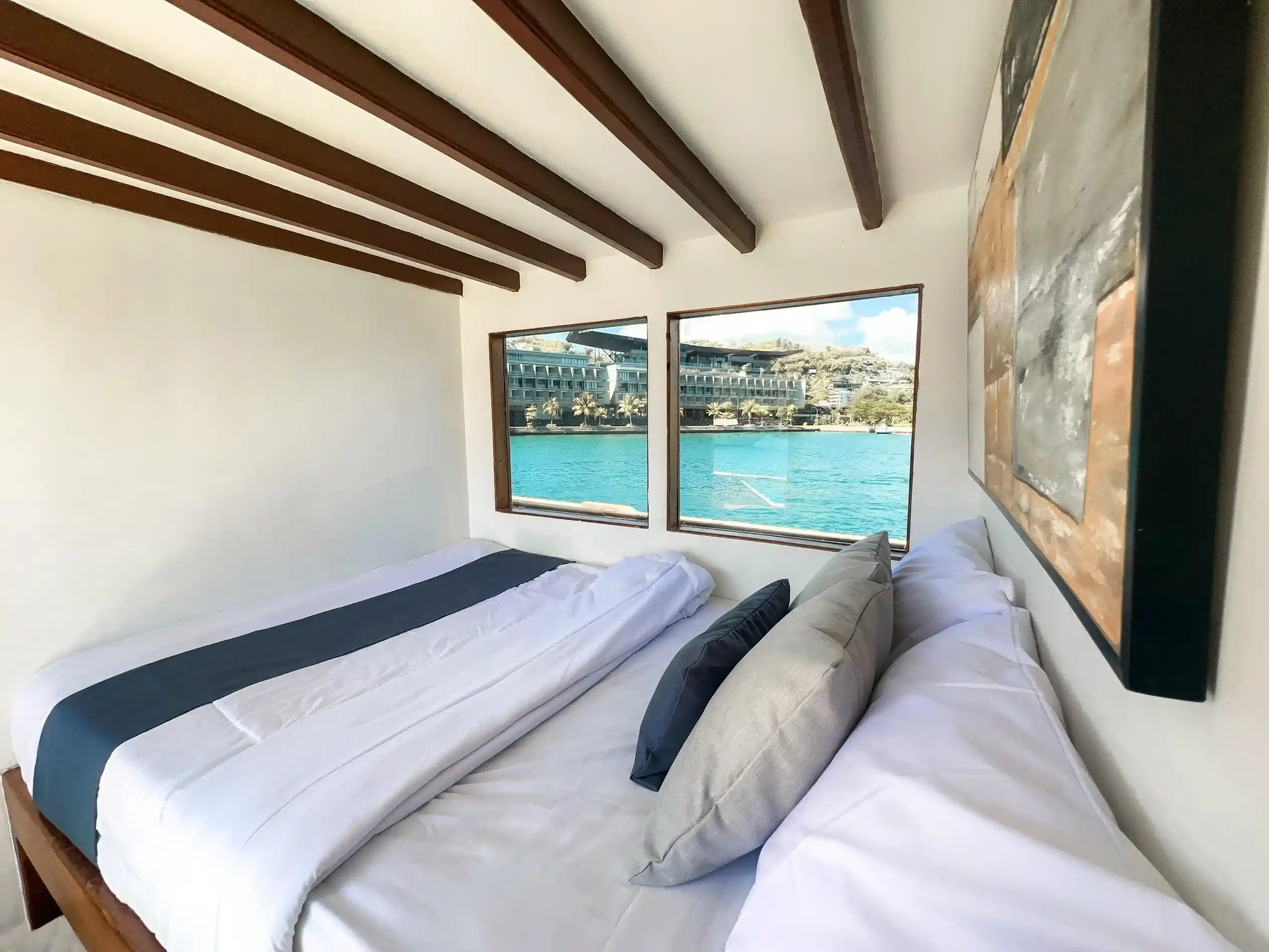
On an open-trip boat, “deck” means sleeping on a mattress in the open air on the shared upper deck for the lowest fare, while a “cabin” gives you a private or shared bunk below deck with a door and usually a fan. Neither is better — the deck is lower-cost, breezier and far more social; a cabin is more private, warmer and steadier when the sea is up. In 2026 the gap is roughly IDR 3,500,000 for a deck spot versus IDR 4,000,000–4,600,000 for a cabin on a four-day Lombok–Flores open trip (rates checked August 2026, park fees paid separately). This guide is about what those two words actually feel like once you are on the water — where you sleep, the toilets, the wifi, the charging, and how to pick the right one for you.
I’m Ratna, a boat-trip coordinator who has worked the Bangsal and Labuan Bajo harbours since 2017, and I have watched thousands of travellers choose deck or cabin and either grin about it or quietly regret it. Below is the honest version I give my own friends. If you want a live seat count or a specific boat’s layout for your dates, message us on WhatsApp +62 811 3823 875 or email [email protected].
Deck vs Cabin at a Glance
Here is the quick comparison most travellers are looking for. Use it to narrow your choice, then read the sections below for the detail a table cannot capture.
| Factor | Open deck | Cabin (shared or private) |
|---|---|---|
| Price (4D3N) | From IDR 3,500,000 pp | IDR 4,000,000–4,600,000 pp |
| Where you sleep | Mattress in the open air, upper deck | Bunk below deck, door that closes |
| Temperature | Cool, breezy, occasional spray | Warmer, fan-cooled; some air-conditioned |
| Privacy | None — you sleep in a row | Private, or shared with one other |
| Social feel | Very high — you meet everyone | Quieter, more couple/family |
| Best in rough seas | Harder — motion and spray | Steadier, more sheltered |
| Best for | Solo travellers, backpackers, value-minded | Couples, light sleepers, seasickness-prone |
For the full route, departure days and operator-by-operator rates behind these prices, see the complete Lombok to Flores boat trip guide, or the Komodo open trip page if you are sailing round-trip from Labuan Bajo.
What Sleeping on the Open Deck Is Really Like
The deck is a row of thin mattresses laid side by side under a canvas roof on the upper level of the boat, with a light blanket or a sarong you bring yourself. You sleep in the open air, so the temperature is pleasant on a calm night and the stars over the Sumbawa strait are the best you will ever see. It is also the reason the deck fare sits at the value end of every operator’s price list.
The trade-offs are real and worth knowing before you book. There is no privacy — you change in the bathroom and sleep next to strangers who tend to become friends by Day 2. Early risers and the engine will wake you, so light sleepers should pack an eye mask and earplugs. On a windy night you may catch a little spray, and in the rough December–February season the deck can be genuinely uncomfortable. But on the calm June–September nights when most people travel, deck sleepers are usually the happiest passengers on the boat. If you are the kind of traveller who wants to talk to everyone and does not mind roughing it, the deck is not a compromise — it is the point.
What a Cabin Gets You (Shared and Private)
A cabin is an enclosed room below deck with one or two bunks, a door that locks, and almost always a fan; the larger, better-equipped boats add air-conditioning and a small private bathroom. You are paying for privacy, a safe place to leave your bag, and a warmer, more sheltered night when the sea is moving.
Two honest caveats. First, on the value boats a “cabin” can be small, warm and low-ceilinged — below the waterline, a fan-only cabin on a hot, still night is sometimes stuffier than the open deck. Second, cabins closest to the engine are noisier, so if you can choose, ask for one toward the bow. Where a cabin truly earns its extra rupiah is on a rough crossing, for couples who want privacy, for families with young children, and for anyone prone to seasickness who sleeps better lying flat behind a closed door. For context, comparable Komodo and Lombok–Komodo open-trip cabins are advertised internationally at roughly USD 350–750 per person, so the local IDR cabin rates above are the value end of that market. For the full breakdown of what every class costs across every route, see the flores boat trip cost table.
Toilets, Showers and Water on Open-Trip Boats
Almost every open-trip boat has one or two shared bathrooms with a simple Western or squat toilet and a freshwater shower — basic but functional, and shared by the whole deck. This is the question I am asked more than any other, so here is the plain truth.
- Toilets: shared, simple and cleaned by the crew, but they see heavy use with 15–25 people aboard. Bring your own toilet paper and hand sanitiser — boats rarely stock them.
- Showers: usually a freshwater tank shower or a bucket; on smaller boats the “shower” is the sea followed by a freshwater rinse. Water is limited, so keep it short.
- Fresh water: drinking water, tea and coffee are refilled on board, but washing water is rationed — do not expect a long hot shower.
None of this is luxury, and that is exactly what the price reflects. Pack a quick-dry towel, biodegradable soap and dry shampoo and you will be perfectly comfortable in either class. Our full what to pack on a Komodo boat trip list covers the toiletries that make deck life easy.
Wifi, Signal and Charging at Sea
Do not expect wifi on an open-trip boat — almost none have it, and mobile signal disappears for long stretches inside Komodo National Park and mid-strait. You will get patchy 4G near Labuan Bajo, around some inhabited islands and near Bangsal, and nothing at all on the open-water legs.
Treat the crossing as a genuine digital detox. Charging is the real practical issue: boats usually have a few shared 12V or 220V sockets near the engine or bridge, but they are limited and not always reliable, so a power bank is essential kit — ideally two if you shoot a lot of photos. Download your maps, music and shows before you board, tell family you will be off-grid for a few days, and buy a local eSIM or Telkomsel SIM in Lombok or Labuan Bajo for the best chance of a signal at the stops. Honestly, the missing wifi is part of why the boat feels the way it does: people actually talk to each other.
How to Choose a Komodo Boat Cabin (or the Deck)
Choose the open deck if price and atmosphere matter most and you are travelling in the calm season; choose a cabin if you value privacy, travel as a couple or family, sleep badly, or are crossing in the rougher months. Here is how I match travellers to a class at the harbour:
| You are… | I usually suggest |
|---|---|
| A solo traveller or backpacker on the value end | Open deck — social, lowest fare, most fun |
| A couple wanting privacy | Private cabin |
| A family with young children | Cabin — a base to nap and store gear |
| Prone to seasickness | Cabin, mid-boat — lie flat, stay sheltered |
| Travelling Dec–Feb (rough season) | Cabin — the deck can be wet and rolly |
| Travelling Jun–Sep on a budget | Open deck — calm nights, great value |
Whichever you lean toward, book early in the July–August peak: cabins are the first thing to sell out, and deck spots fill fast on the popular boats. Season matters as much as class, so weigh your choice against the best time for a Flores boat trip and be honest with yourself about the water — our guide to whether the Lombok–Flores crossing is rough will tell you if a cabin is worth it for your dates.
Small Boat-Life Tips That Make Either Class Better
A few Komodo boat trip tips I give every guest, whichever class they pick:
- Pack soft luggage. Hard suitcases are awkward to stow; a duffel or backpack slides under a bunk or along the deck.
- Bring a headlamp. Boats dim their lights at night and the walk to the bathroom is dark.
- Two power banks. Sockets are scarce; keep your phone and camera alive for the Padar sunrise.
- A sarong does everything — blanket, towel, sun cover and privacy screen in one.
- Motion-sickness tablets taken the night before an open-water leg work far better than waiting until you feel ill.
- Cash in small notes for park fees and tips — there is no card machine at sea or at the park gate.
Get those right and the deck-versus-cabin question shrinks to what it really is: a matter of budget and sleeping style, not of having a good trip or a bad one. Both classes see the same dragons, the same Padar sunrise and the same manta rays. To see exactly what your fare does and does not cover before you choose, read what’s included in an open trip price.
Still weighing deck against cabin for your dates? Tell us your travel days, group size and how you like to sleep on WhatsApp +62 811 3823 875 or [email protected], and we will match you to the right boat and class with live availability — no obligation.
Frequently Asked Questions
What is the difference between deck and cabin on an open trip?
Deck class means sleeping on a thin mattress in the open air on the shared upper deck — the lowest-cost, breeziest and most social option. A cabin is an enclosed room below deck with a private or shared bunk, a door that locks and usually a fan, for more privacy, warmth and shelter when the sea is up. Deck suits solo travellers and backpackers; cabins suit couples, families and light sleepers.
Is deck or cabin better for a Komodo boat trip?
Neither is objectively better — it depends on you. On the calm June to September nights, most travellers are happiest and best value on the open deck. Choose a cabin if you want privacy, are travelling as a couple or family, sleep badly, get seasick, or are crossing in the rough December to February season when the deck can be wet and rolly.
How much more does a cabin cost than deck class?
On a four-day Lombok to Flores open trip in 2026, a deck spot starts from about IDR 3,500,000 per person while a cabin runs IDR 4,000,000 to 4,600,000 per person (rates checked August 2026, park fees paid separately). So a cabin is usually IDR 500,000 to 1,100,000 more than the deck. Comparable international open-trip cabins are advertised at roughly USD 350 to 750 per person.
Do open-trip boats have wifi?
Almost none do. Expect no wifi and no reliable mobile signal across the open-water legs and inside Komodo National Park; you get only patchy 4G near Labuan Bajo, Bangsal and some inhabited islands. Treat the crossing as a digital detox, download maps and entertainment before boarding, and bring a power bank because charging sockets on board are scarce.
What are the toilets and showers like on a Komodo boat?
Basic but functional. Most open-trip boats have one or two shared bathrooms with a simple Western or squat toilet and a freshwater tank or bucket shower, used by the whole deck. Washing water is limited, so keep showers short. Bring your own toilet paper, hand sanitiser and a quick-dry towel, as boats rarely stock them.
Can you charge your phone on an open-trip boat?
Sometimes, but not reliably. Boats usually have a few shared 12V or 220V sockets near the engine or bridge, but they are limited and often busy with 15 to 25 passengers aboard. Carry at least one power bank, ideally two if you take a lot of photos, so your phone and camera survive to the Padar sunrise.